
Pakistan Navy Adds Second Milgem Corvette PNS Khaibar to Fleet
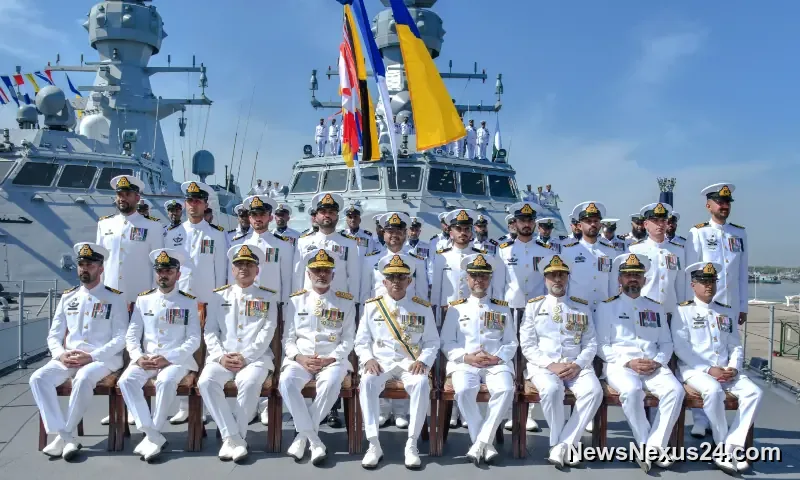
“Pakistan has inducted PNS Khaibar, the second Milgem-class corvette, into its navy under a four-ship programme with Turkiye.”
Key points
- Pakistan has inducted PNS Khaibar, the second Milgem-class corvette, into its navy under a four-ship programme with Turkiye.
- The move strengthens maritime capability and highlights Islamabad’s focus on naval modernisation, sea-lane security and defence cooperation.
Pakistan on Saturday formally inducted PNS Khaibar, the second Milgem-class corvette, into the Pakistan Navy, marking another major step in the country’s ongoing naval modernisation drive. The ceremony underscored Islamabad’s effort to strengthen maritime readiness at a time when sea routes, regional deterrence and defence partnerships are drawing growing strategic attention.
The warship is the second vessel under a four-ship Milgem programme agreed with Turkish defence contractor ASFAT in 2018. Under the arrangement, two ships are being built in Turkiye and the remaining two in Pakistan, a structure designed not only to deliver new platforms but also to expand local shipbuilding capacity and technical expertise.
At the induction event, naval leadership linked the arrival of the corvette to Pakistan’s wider maritime security requirements. Officials stressed that the country’s location along key trade and energy corridors makes sea security a national priority, especially as regional tensions and global shipping risks continue to affect strategic calculations.
Chief of the Naval Staff Admiral Naveed Ashraf said the navy must remain prepared to defend Pakistan’s interests at sea and protect vital lines of communication. He also used the occasion to project confidence in the service’s operational posture, saying the navy’s recent readiness and conduct had shown that any challenge to Pakistan’s maritime space would invite a firm response.
Beyond the ceremony, the induction carries industrial and diplomatic significance. The Milgem collaboration has become one of the most visible examples of Pakistan-Turkiye defence cooperation, combining procurement, technology transfer and long-term naval planning. The programme has also been presented as part of Pakistan’s attempt to field more capable multi-role surface combatants able to operate in both wartime and peacetime missions.
PNS Khaibar had already been commissioned at Istanbul Naval Shipyard in December 2025, but its induction into the active fleet gives the platform operational relevance inside Pakistan’s naval structure. The project’s timeline shows continuity in a programme that has moved through multiple stages, including the launch of work on the third ship in earlier years.
For Pakistan, the addition is not just about numbers. Newer corvettes are intended to improve surveillance, maritime interdiction, fleet support and deterrence in waters linked to commerce, energy imports and regional competition. As the Arabian Sea remains central to Pakistan’s security thinking, each new induction also feeds into a broader message of preparedness.
The development comes as maritime security has gained renewed prominence across South Asia and the wider region. Naval capability is increasingly seen as essential not only for combat but also for securing shipping lanes, supporting allied operations, responding to crises and protecting economic interests connected to ports and sea-borne trade.
With two Milgem corvettes now accounted for under the programme, attention is likely to shift to the delivery of the remaining ships and how quickly they can be integrated into frontline operations. Their eventual deployment will be watched closely as a measure of Pakistan’s naval ambitions and the depth of its defence-industrial partnership with Turkiye.
Corrections & clarifications
Spot an inaccuracy or need more detail? Email connect@newsnexus24.com. Significant updates are timestamped above.


