
Pakistan army warns Saudi attacks could derail Middle East peace push
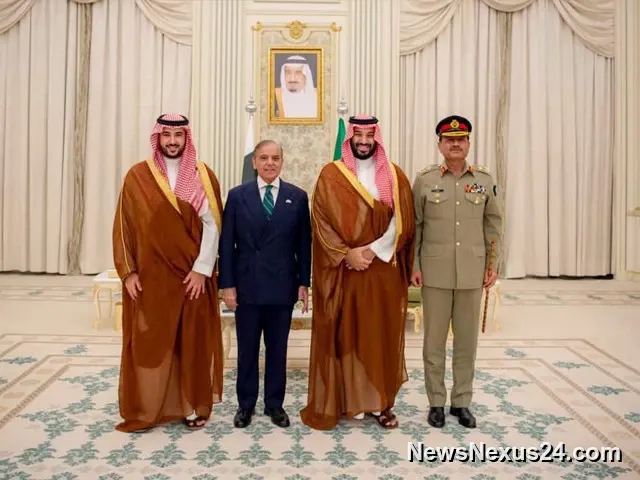
“Pakistan’s military leadership has condemned attacks on Saudi industrial sites and warned that further escalation could wreck fragile Middle East peace efforts.”
Key points
- Pakistan’s military leadership has condemned attacks on Saudi industrial sites and warned that further escalation could wreck fragile Middle East peace efforts.
- The statement, backed by Prime Minister Shehbaz Sharif’s message of solidarity to Riyadh, underscores Islamabad’s concern over regional stability, diplomacy and the economic risks of a wider conflict.
Pakistan’s military leadership on Tuesday issued one of its strongest statements yet on the widening Middle East conflict, condemning attacks on Saudi Arabia’s petrochemical and industrial facilities and warning that the escalation could damage ongoing diplomacy. The position was announced after the 274th Corps Commanders’ Conference at General Headquarters in Rawalpindi, chaired by Chief of Army Staff and Chief of Defence Forces Field Marshal Asim Munir.
The military’s message placed the latest strikes in a broader regional context rather than treating them as an isolated security event. According to the official statement, the commanders viewed the attacks as a dangerous step that could spoil efforts aimed at a negotiated outcome in the conflict. By framing the incident as a blow to peace efforts, the army signalled that Pakistan is deeply concerned not only about immediate security fallout but also about the collapse of the diplomatic space that still exists.
The statement also highlighted Saudi Arabia’s conduct during the crisis, saying Riyadh’s restraint had helped keep mediation channels open despite serious provocation. That assessment is significant because it aligns Pakistan’s military view with its diplomatic messaging and reinforces Islamabad’s public support for de-escalation. At a time when regional powers are being pulled into sharper alignments, Pakistan appears to be trying to back Saudi Arabia politically while still advocating a negotiated end to the wider confrontation.
Pakistan’s civilian leadership echoed that line. Prime Minister Shehbaz Sharif separately spoke with Saudi Crown Prince Mohammed bin Salman and conveyed solidarity with the kingdom after the attack on the Al Jubeil oil facility. The prime minister also praised Saudi restraint and repeated Pakistan’s support for efforts to calm the region. Together, the military and civilian responses suggested a coordinated state position on one of the most sensitive external crises now affecting the Muslim world.
The conference was not limited to the Middle East. The commanders also reviewed Pakistan’s internal and external security situation, including ongoing counterterrorism operations. The military leadership reaffirmed that Operation Ghazab lil-Haq would continue until militant sanctuaries and the use of Afghan soil against Pakistan were decisively addressed. That linkage is important because it shows the army is attempting to manage two fronts at once: a volatile regional environment abroad and a persistent militant threat at home.
Another notable part of the statement dealt with India. The commanders rejected what they described as disinformation and false narratives attributed to New Delhi, and also raised concern over human rights violations in Indian Illegally Occupied Jammu and Kashmir. By bringing India into the discussion, the military signalled that even while the Middle East dominates headlines, Pakistan’s strategic establishment remains alert to what it sees as pressure points on its eastern front.
The background makes the latest statement even more consequential. Pakistan and Saudi Arabia signed a strategic mutual defence agreement last year, deepening an already close security relationship. In that framework, any serious attack on either side carries implications that go beyond routine diplomacy. Pakistan therefore has a direct interest in preventing the Saudi front from becoming a larger theatre of war, especially when global energy routes and Gulf stability are already under strain.
For Pakistan, the impact of such escalation is not abstract. Any major disruption in Gulf energy infrastructure can quickly feed into higher import costs, inflation and broader financial stress at home. Pakistan is heavily exposed to external oil price shocks, and a prolonged conflict involving Saudi facilities or regional shipping lanes would likely intensify pressure on consumers, transport costs and macroeconomic stability. That gives Islamabad both strategic and economic reasons to push for restraint.
The next phase will depend on whether regional actors step back or answer new strikes with broader retaliation. Pakistan’s top military commanders have now made clear that they see continued aggression as a threat to peace efforts and to regional order more generally. If diplomacy holds, Islamabad may continue positioning itself as a supporter of de-escalation and mediation. If the conflict widens, however, Pakistan could find itself navigating a far more difficult balance between strategic partnerships, regional stability and domestic economic vulnerability.
Corrections & clarifications
Spot an inaccuracy or need more detail? Email connect@newsnexus24.com. Significant updates are timestamped above.


