
EU and India seal landmark trade pact after two decades of talks
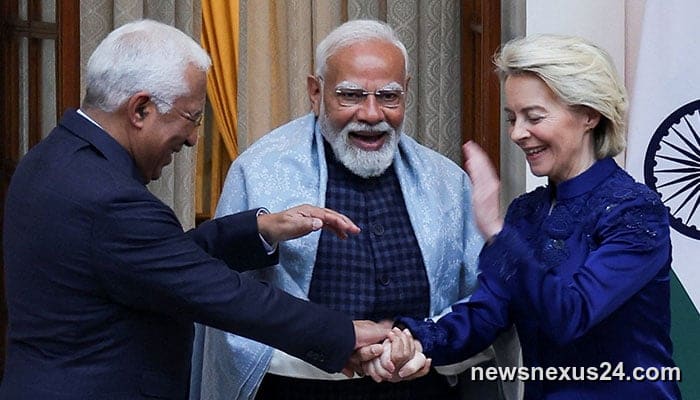
“India and the EU announced a sweeping trade pact after two decades of negotiations, aiming to create a market of about two billion people.”
Key points
- India and the EU announced a sweeping trade pact after two decades of negotiations, aiming to create a market of about two billion people.
- The deal would cut tariffs on most European exports and reduce duties on cars and wines, while opening access across services and other sectors.
India and the European Union on Tuesday announced a major trade agreement described by both sides as a historic breakthrough after roughly two decades of negotiations.
The deal is intended to create a vast market spanning around two billion people and is being positioned as a strategic move as New Delhi and Brussels seek to diversify trade and reduce vulnerability to external shocks linked to the United States and China.
EU officials said the agreement would cut or remove tariffs on nearly 97% of European exports, translating into annual duty savings estimated at about €4 billion (roughly $4.75 billion). Indian Prime Minister Narendra Modi, meeting European Commission President Ursula von der Leyen and European Council President Antonio Costa in New Delhi, said the pact would open new opportunities for India and the EU and noted the combined economic weight of the partners.
According to the EU, the pact offers European businesses the highest level of access it has ever received in the traditionally protected Indian market, with expected gains for key European sectors such as agriculture, automobiles and services. EU leaders also suggested exports to India could potentially double over time.
Market-opening measures highlighted in the announcement include a phased reduction in tariffs on cars from a peak rate of 110% to as low as 10%, and a gradual reduction in duties on wine from 150% to as low as 20%. The EU also said India would eliminate a 50% tariff on processed foods such as pasta and chocolate.
Officials said European companies would receive improved entry into Indian financial services and maritime transport, while India expects benefits for sectors such as textiles, gems and jewellery, leather goods and services.
Sources familiar with the talks said negotiations went to the wire, including discussions over the potential impact of the EU’s carbon border mechanism on steel. Alongside the trade deal, India and the EU were expected to move forward on arrangements related to mobility for seasonal workers, students, researchers and highly skilled professionals, as well as a security and defence pact.
European officials and Indian leaders framed the agreement as part of a broader push to build new markets amid shifting global trade conditions. The report also noted India’s efforts to diversify defence procurement and Europe’s interest in reducing dependence on the United States in certain areas.
Corrections & clarifications
Spot an inaccuracy or need more detail? Email connect@newsnexus24.com. Significant updates are timestamped above.


