
Nobel in Medicine honors trio behind immune system ‘security guards’
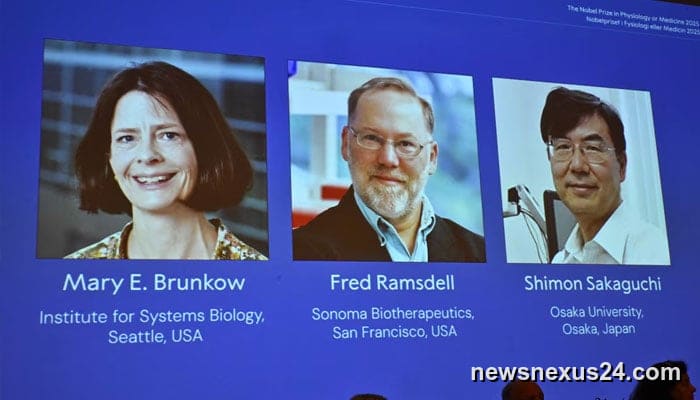
“Brunkow, Ramsdell and Sakaguchi win the Nobel for uncovering regulatory T cells.”
Key points
- Brunkow, Ramsdell and Sakaguchi win the Nobel for uncovering regulatory T cells.
- Their work explained how immune tolerance prevents autoimmunity outside the thymus.
- Key milestones include Sakaguchi’s 1995 discovery and 2001 Foxp3 gene findings.
- The research seeded therapies now being trialed for autoimmune disease and cancer.
A US–Japanese team won the 2025 Nobel Prize in Physiology or Medicine for landmark work that revealed how the body prevents the immune system from attacking itself by identifying so-called “security guards” of immunity — regulatory T cells. The Nobel Assembly said the discoveries have been decisive for understanding immune function and the origins of autoimmune disease, opening a path to potential treatments now under clinical evaluation.
The laureates are Mary E. Brunkow and Fred Ramsdell of the United States and Shimon Sakaguchi of Japan. Their research established how immune tolerance is maintained beyond the thymus, a concept known as peripheral tolerance, and explained why failures in this system can unleash devastating autoimmunity.
Speaking to Swedish radio, Sakaguchi said it was an honor to be recognized and that he looked forward to receiving the award in person in Stockholm this December. The head of the Nobel Assembly, Thomas Perlmann, quipped at the announcement that the committee had been unable to reach the US-based winners directly and urged them to “call me.”
Sakaguchi made the first key breakthrough in 1995 when he identified a then-unknown population of T cells that suppress harmful immune responses and protect against autoimmune disease. In 2001, Brunkow and Ramsdell traced severe immune dysregulation in mice to mutations in the Foxp3 gene, and linked analogous mutations in humans to the rare but serious autoimmune syndrome IPEX, knitting together a genetic explanation for loss of tolerance.
According to the jury, the field launched by these findings now underpins efforts to treat a spectrum of illnesses — from autoimmune conditions to certain cancers — by modulating the activity of regulatory T cells. The committee said the “hope is to treat or cure autoimmune diseases, deliver more effective cancer therapies and prevent transplant complications.”
This year’s Nobel medal, diploma and roughly $1.2 million prize will be presented in Stockholm on December 10. The announcement also arrived amid debate over research funding, with observers noting recent US federal cutbacks to science programs and their potential long-term impact on basic research.
Nobel watchers additionally turned attention to other prizes due this week. Commentators speculated on possible Peace Prize contenders, ranging from Sudan’s volunteer Emergency Response Rooms to press-freedom groups such as the Committee to Protect Journalists and Reporters Without Borders, and Yulia Navalnaya, widow of the late Russian opposition leader Alexei Navalny.
Corrections & clarifications
Spot an inaccuracy or need more detail? Email connect@newsnexus24.com. Significant updates are timestamped above.


